The Ramsays’ Marriage
To the LighthouseThe Ramsays’ Marriage is a bond of deep attachment whose moments of tenderness are inseparable from unequal emotional labor, concealment, and strain. Mrs Ramsay can soothe her husband’s despair and receive his affection, yet she also feels that she cannot always speak truthfully to him or be entirely herself beside him. Their marriage offers genuine intimacy, but never a simple escape from the demands of family life or the solitary realities each keeps within.
Authority, Truth, and the Lighthouse Dispute
When Mr Ramsay insists that the weather makes the next day’s trip to The Lighthouse impossible, Mrs Ramsay counters that the wind might change. His anger is sharpened by his conviction that he must not soften facts to spare anyone’s feelings; to him, her hopeful reply gives the children a hope that the evidence does not warrant. To her, however, this pursuit of truth without regard for feeling is a breach of human decency. She receives his outburst in silence, as if enduring a storm, while he eventually offers to ask the Coastguards whether the trip might be possible.
The dispute exposes more than a disagreement about weather. Mrs Ramsay reveres her husband, takes his word readily, and feels unworthy even to tie his shoelaces; at the same time, his abrupt certainty and anger wound her. Once he has changed his position and says that it will not rain, she feels the relief of security opening before her. The scene shows how his authority can distress her and then reassure her, while her own more generous, hopeful way of speaking is treated as irrational even when the outcome remains uncertain.
Need, Consolation, and the Work of Care
Mr Ramsay’s need for sympathy recurs in the quieter scene with Mrs Ramsay and James. James hates his father for interrupting the closeness between mother and son and demanding their attention. Mr Ramsay declares himself a failure, and Mrs Ramsay responds first with a brief allusion to Charles Tansley, then with the reassurance he still wants: confirmation of his genius and restoration to the circle of family life. Her comfort leaves him grateful and renewed; he goes to watch the children play cricket.
The emotional balance is costly. As soon as Mr Ramsay has gone, Mrs Ramsay folds inward with exhaustion, though she experiences the effort’s creative rapture as well. The image of two notes sounding together captures the real solace their closeness can provide, but its resonance fades. She dislikes feeling finer than her husband, and she is troubled that his open dependence on her might lead others to think that he, the more important figure, depends on her. His intellectual work—his books, lectures, and the demand for him at universities—seems to her weightier than what she gives the world, although the household’s emotional life relies on what she provides.
Her care is not the same as unqualified honesty. She fears telling him that repairing the greenhouse roof may cost fifty pounds and worries that his latest book may not be his best. She also conceals smaller everyday matters, conscious that the children see the concealment and that it burdens them. These silences diminish the joy she takes in their shared comfort: the marriage can soothe Mr Ramsay without making it easy for Mrs Ramsay to speak freely to him.
Solitude and Moments of Mutual Recognition
The marriage does not erase the private self each partner cannot fully reach. Alone with her knitting and the light of The Lighthouse, Mrs Ramsay resists easy religious consolation and recognizes a world without guaranteed justice, where suffering, death, and poverty remain. Mr Ramsay notices her stern remoteness but feels unable to protect or help her. His concern is itself painful: he believes his irritability and his conduct over the Lighthouse have made her life harder, yet he can only stand by and watch.
At another moment, he sees her absorbed in her solitude and chooses not to interrupt. She is distant from him in her beauty and sadness; he wants to speak but lets her be. The connection resumes by her own choice: she takes a green shawl from a picture frame, wraps it around herself, and goes to him. As they walk arm in arm, she talks about the gardener and the greenhouse rather than telling him the fifty-pound cost on the tip of her tongue. Their companionship is tender, but even this easy walk carries an unsaid worry.
A more direct exchange comes when Mr Ramsay takes Mrs Ramsay’s hand, kisses it intensely, and quickly lets it go. She is moved to tears. She admires his strength and the way his conviction about terrible things does not simply depress him, while also observing how little he notices ordinary surroundings such as flowers, the view, or the food at table. The episode gives the marriage a language of touch and affection, but preserves the difference between them: his attention is drawn to what she feels he misses, just as her efforts to understand him cannot make their perspectives identical.
Domestic Partnership and Its Pressures
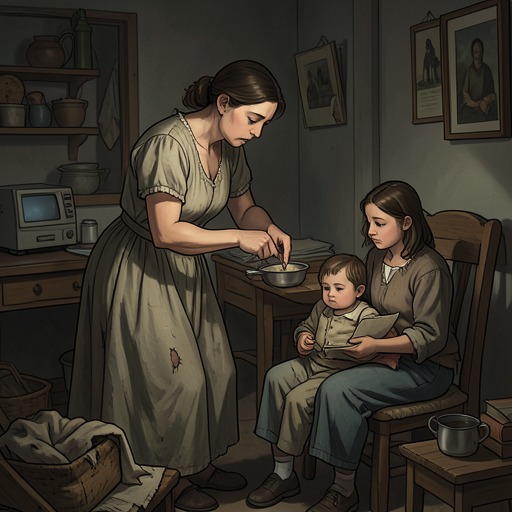
Marriage is woven into Mrs Ramsay’s work of caring for a large household. She knits a reddish-brown stocking for the Lighthouse keeper’s little boy, whose hip is threatened by tuberculosis, and imagines sending the family old magazines and tobacco as comforts for the isolated keepers. She measures the stocking against James’s leg, finding it at least half an inch too short for the boy it is meant to fit. These practical acts of attention sit alongside her concern for her husband’s emotional needs and her sense that people come to her throughout the day wanting one thing or another.
Her account of domestic responsibility also extends beyond her own home. She wants a hospital on the island and a clean, model dairy, distressed that there is no hospital and that milk delivered in London can be brown with dirt. But she wonders when she could undertake such work while caring for her children. Her care is thus both intimate and civic in imagination, while the time and obligations of family life constrain what she can do. When she thinks of her children growing up, she fears the losses and unhappiness ahead, yet recognizes that her attempts to make marriage and children seem necessary may be a way of escaping her own unspoken experiences. The marriage sits within this pressure to treat family life as a prescription, even as her private reflections complicate that ideal.
The household’s ordinary rituals make care visible in a different register. Before the dinner party, Mrs Ramsay worries that the guests are late and that the carefully prepared boeuf en daube will be spoiled if it cannot be served at the right moment. She lets Rose linger over choosing a necklace for her black dress, understanding that this repeated ceremony matters to her daughter. The scene presents the work of sustaining family and hospitality as a web of attention—timing food, guiding children, and recognizing their attachments—rather than as a single act of sacrifice. It also gives the marriage its shared domestic setting, where Mr Ramsay’s intellectual importance and Mrs Ramsay’s largely uncelebrated labor coexist.
Loss, Memory, and the Marriage’s Afterlife
The passage of time reveals the vulnerability of the family life the marriage helped sustain. Prue is given in marriage, praised for her beauty, and then dies that summer from an illness connected with childbirth. Andrew is killed when a shell explodes in France. These deaths do not describe a quarrel between the spouses, but they make the surrounding family’s promises of marriage, children, and continued happiness impossible to take for granted.
Mrs Ramsay herself dies suddenly in London. Years later, Mrs McNab finds her clothes still in the house, including the old grey gardening cloak, with a brush, comb, handkerchiefs, and bits of ribbon left behind as if she might return. The domestic remnants give physical form to an absence that the family home has not absorbed. The surviving account of the marriage is consequently shaped not only by its moments of consolation but by the loss of the person whose care had organized so much of its daily life.
The marriage’s significance lies in this unresolved doubleness. Mrs Ramsay and Mr Ramsay love one another and can share tenderness, relief, and a brief harmony, yet their intimacy depends on efforts that are not evenly visible: she steadies him, while privately carrying doubts and withholding worries; he needs her consolation, but his demands and bluntness can deepen her loneliness. Their bond neither abolishes those differences nor becomes false because of them. It is a real attachment lived amid emotional dependence, domestic labor, and the knowledge that neither spouse can wholly protect the other from life’s losses.